Search This Blog

Showing posts with label quartz. Show all posts

Sunday, 24 March 2024

  WHERE ARE SAPPHIRES FOUND?


                                   pyrope, sapphire and zircon from Yarrow Creek

There are two kinds of gem deposits in the Glen Innes area: Primary and Secondary or alluvial. 

The primary deposits are those containing the gems in the original rock or weathered material formed from it. The secondary deposits are concentrations found in present day streams, abandoned stream channels and deep leads or buried stream channels. 

The only primary deposits the casual fossicker is likely to meet are at the DeJon mine on the Gwydir Highway at Elsmore and at the Wellingrove Fossicking Reserve.


                                                      Quarry at DeJon mine

At the Wellingrove Reserve, there is no sign of the overlying basalt, though it is visible in road cuttings just before the turnoff into the Reserve. The sapphires are found in reddish clay overlying the Wellingrove granite. This clay is evidently the weathered remains of volcanic material ejected over the area immediately before the outpouring of the basalt. Fossickers will soon notice the absence of typical water worn sand and pebbles in the so-called "wash". The greatest concentration of gems is in the bottom few centimetres of clay, which may be buried beneath several metres of soil.

 
            Wellingrove wash and granite boulders

Alluvial deposits are found in stream beds all over the district. The major requirement for finding concentrations of gems is to be searching in an area where there are outcrops of bedrock in the creek to act as traps. Otherwise the dense gemstones will be buried deeply in the gravel and inaccessible to the casual fossicker. This rules out most of Reddestone, Wellingrove and Furracabad Creeks and the Beardy Waters. In other places, it's necessary to think of how the water behaves in a major flood, because this is the only time the dense gemstones are actually shifted. They will then be deposited in places where there is a sudden decrease in stream velocity such as in the lee of boulders, below rapids etc. These are the places to identify and search for the best results.


     Where Do Sapphires Come From?


Throughout NSW and Queensland, sapphires are nearly always found in areas where basalt rock has been eroded. Occasionally one turns up in a basalt floater (loose piece of solid basalt) or in soil overlying basalt rock and clearly formed from it by weathering. 

It's believed that some sapphires are found throughout the extensive basalt lava flows of New England, brought up from deep within the Earth by rising magma some 37 million years ago. The result is that almost every stream between Glencoe and Dundee, Glen Elgin and Inverell holds its quota of marvellous blue, green, yellow and particolour sapphires.


                                  digging for gravel in Yarrow Creek

                                                 Sapphires from Rainy Swamp
Investigations at Elsmore and in the Kings Plains and Wellingrove areas suggests that the greatest concentration of sapphire and the other dense minerals is in volcanic ash beds which lie below the first great lava sheets. These are the product of the explosive activity which took place when the volcanic cycle commenced. Weathering of these rocks has released the precious stones to be concentrated in modern creeks and ancient deep leads by virtue of their greater hardness and density. 

The distribution of sapphires suggests that other explosive centres may have been located near Mt. Slow, Glencoe, Furracabad and Bald Nob. The search is on to locate sapphire bearing rocks in these places. If these deposits prove to be economic, Glen Innes will be a source of precious stones for hundreds of years to come.

   Minerals Found in Gem Gravels. 

The process of concentration which takes place during sieving should separate out all the dense minerals found in the wash. The other materials, mostly pebbles of various rocks and quartz (as worn

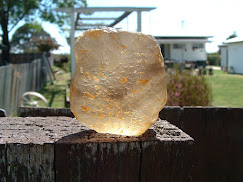
                                                 Smoky quartz Yarrow Creek


          quartz from Garnet Corner

crystals and vein fragments) have specific gravities between 2.5 and 3.1.  That is, they are 2.5 to 3.1 times denser than water. Of these, only some of the crystalline quartz is likely to interest the fossicker.

 The denser minerals, with their specific gravities, are as follows:   

               corundum (sapphire & ruby)    4.0                                                       pleonaste (black spinel, commonly called blackjack)   4.1               zircon    4.7                                                                                            garnet (most often pyrope)  3.5-3.7                                                        topaz   3.4-3.6                                                                                         enstatite  and hypersthene   3.2 - 3.5       

              tourmaline (the black schorl variety)   3.0 - 3.3                                    cassiterite   6.8-7.1                                                                               "ironstone" (ferruginous bauxite)  2.5 - 4.0                                                   depending  on the iron content. 

Not all of these will be found together. The typical sapphire concentrate will consist of ironstone, corundum, zircon, garnet and pleonaste; less commonly topaz and enstatite will turn up. Tourmaline and cassiterite can be expected in tin areas around Backwater, Tingha, Emmaville and Torrington. 

 How to Recognise the Various Minerals. 

Nothing beats being shown by an expert, but it is comparatively easy to distinguish the various minerals.  Ironstone is opaque, reddish brown to black which crushes to a red powder.  Pleonaste is invariably found with sapphire in New England. It is black and lustrous and occasionally confused with corundum, especially on bright sunny days.

                                        Pleonaste (spinel, blackjack) Rainy Swamp

 Corundum is the mineralogical name of the mineral whose transparent varieties include ruby and sapphire. The name ruby is reserved for the red variety of corundum, all other colours being
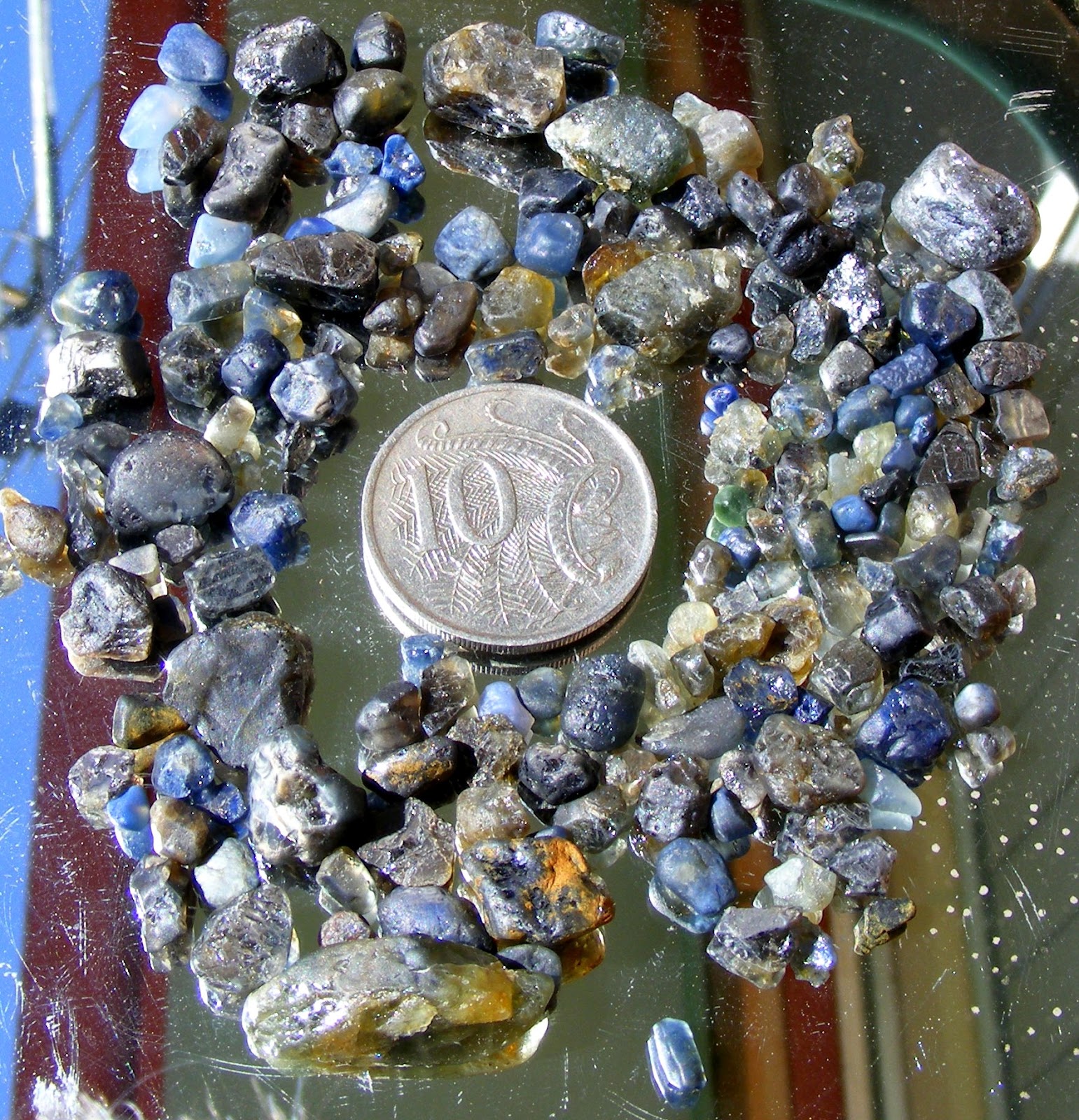
                                                  Corundum from Yarrow Creek
known as sapphire. To the miner, the term "corundum" means the nongem quality mineral.  It occurs in barrel shaped hexagonal crystals, pieces of crystals and rounded fragments. These may be up to 4 cm across. If broken, the mineral usually displays flat, very lustrous parting surfaces. Colour zoning both along and across the crystal is common.  

Zircon is plentiful, being usually a reddish brown colour. It can, however, be pale pink or colourless. The stones may show some crystal faces but are more often rounded.  

                                                     Zircon from Pretty Valley

Zircon is a highly lustrous mineral with a high refractivity which sets it apart from other minerals in the wash. Zircons have been found up to 3 cm across. 

Pyrope garnet is characteristically deep red in colour and usually dull in lustre (unlike zircon). Garnets frequently have rough, irregular surfaces, again unlike zircons which often display flat cleavage surfaces.

                                              Pyrope garnet from Yarrow Creek

Topaz is found as colourless to pale blue pebbles, sometimes 2 or 3 cm in diameter. Highly reflective cleavage surfaces are commonly seen, which distinguishes topaz from quartz but not necessarily colourless zircon. Topaz pieces tend to be larger than the other gemstones.

 
       Topaz Scrubby Gully Torrington

Enstatite and hypersthene are somewhat softer minerals than the others. They are occasionally found as brownish green to emerald green fragments which are quite unlike others in the wash.


                                          Enstatite and Hypersthene Yarrow Creek

Tourmaline is occasionally seen as black or brownish crystal fragments which have a characteristically rounded triangular cross section. The sides are often deeply striated.


Tourmaline and sapphire Pretty Valley

Cassiterite is exceptionally dense and has a distinctly metallic lustre. It is usually reddish brown to black and highly lustrous. 

Equipment Needed for Sapphire Fossicking.


Because water is nearly always available, gem fossicking around Glen Innes is comparatively simple. The basic equipment you need is a pair of sieves (coarse and fine), a shovel (the longer the handle the better), a plastic bottle with lid for your finds and a pair of tweezers for picking them out of the concentrate. 

For working hard ground like that at Wellingrove Reserve, a pick and crowbar are very useful. They are also invaluable in moving rocks in stream beds. A long handled shovel can help you get gravel out from under boulders, from pot holes and from cracks in the bedrock. A one metre steel probe is very useful for locating holes under sand or gravel while a jam tin and perhaps a piece of steel wire are excellent for scraping wash out from between boulders where gems have a tendency to get caught. Many people find a yabby pump valuable for extracting wash from cracks and other hard-to-get-at places underwater. 

Song Studies. Bible studies based on hymns and songs

Shoalhaven District Geology.

John G. Paix  ©

Glen Innes Business Enterprise Centre

June 1991


Monday, 11 March 2024

KINGSGATE MINES Part 4

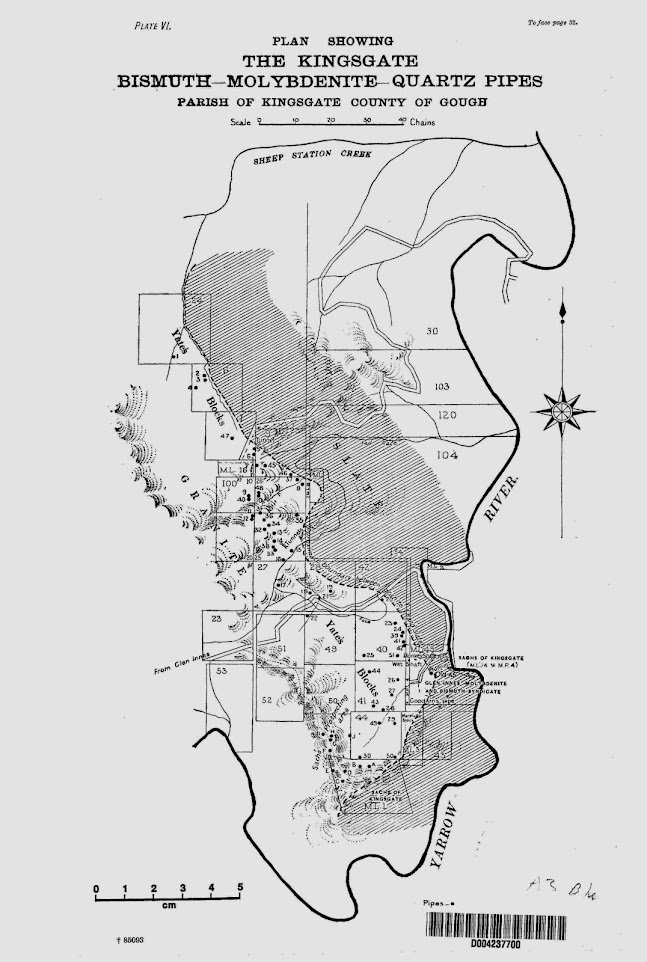
DESCRIPTION AND LOCATION OF THE MAIN PIPES
For much of this information, we are indebted to the geologists of the NSW Geological Survey, in particular to Mr. E.C. Andrews, whose work "The Molybdenum Industry in New South Wales" was published in 1916. To avoid any confusion with names and the numbering system, it needs to be understood that the numbers appearing on the map in Andrews' report are those assigned by Mr. W.H. Yates to pipes under his control in 1915. Numbers appearing as part of names refer to the Portions of Parish Kingsgate and therefore relate to the original mining leases of the 19th Century. Pipes under Sachs' control at that time or under the control of other miners and prospectors were either not numbered at all or assigned letters. The descriptions which follow treat the pipes essentially in order from the north, Portion by Portion.


Portion 24.
1. Known as “Quinn's Find” - a prospect only.

Portion 6. (originally leased by Feeney, Rush and Say in 1879)
2. Dips at 1:2; a branching pipe, an unimportant producer.

3. Prospect only.

4. Small vertical pipe.

Portion 1.
47. The “Swamp Blow”. A prospect north of the present main road in a swampy area.

5. Usually known as the "One and Nine" from its location on the portion boundaries. This pipe has been an important producer of both bismuth and molybdenite and is apparently the site of Quinn's discovery of "sulfur" in 1877. The upper part of the pipe has been mined as an open cut which now lies quite close to the main road. In cross section, the pipe varied in diameter from 1 to 8 metres. It has been mined to a depth of about 85 metres, and consisted essentially of a gangue of well crystallised quartz with rich deposits of bismuth and molybdenite. Vughs lined with crystals of white and black quartz crystals up to 1.2 metres in length were found. Several branches of the main pipe were noted at depth.


6. Prospect only.

Portion 9.
7. The “Water Shaft”, “Tin Shaft” or “Tin Show”. This was the second pipe to be prospected in 1872. Small quantities of cassiterite were found in the quartz. The pipe, which is nearly vertical, has been prospected to a depth of 12 metres.

45. Known as "Jack's at Home". Prospect only.

46. Prospect only.

Portion 100. (Originally in four blocks, leased by Quinn & Ferguson in 1879)
9. “Bill Miller's Hole”. A fairly large but poor pipe prospected to a depth of 10 metres.

40. “Jubilee Pipe”. A surface prospect only.

48. Prospect only.

10. The “Wolfram Pipe”, “Wolfram Blow”, “Old 26” or “Little Tunnel”. This particular pipe was the one originally prospected in 1872. While it contains a little cassiterite in a massive white quartz gangue, the pipe is notable for the quantities of wolframite and arsenopyrite it contains along with the usual bismuth and molybdenite. Both can be readily found on the dumps. Initially mined as an open cut, it was later worked by a tunnel to a depth of 30 metres. The maximum diameter reported was 3.7 metres. Commercial quantities of wolframite were mined here in 1950-52.

31. Prospect only.

37. “Tom Key's Hole” or the “Chimney Shaft”. A fairly small, steeply dipping pipe worked to a depth of over 45 metres.

8. The “Black Shaft” or “26 East”. This large pipe produced substantial quantities of ore in the early days, when it was followed down to a vertical depth of over 40 metres.

11. “Mick's Shaft”. A vertical pipe of moderate dimensions.

12. Prospected at the surface only.

35. The “Granite Shaft”. Instead of the usual quartz, the molybdenite and bismuth were found here in a gangue of granite, in which the felspar was largely sericitised. The pipe, a moderately deep one, dips steeply and branches into two at depth. It has been mined to a depth of at least 40 metres. For the first 30 metres, the ore occurred in the granite itself. One branch continued as granite, the other was a typical quartz pipe.

36. Known as the “25 Northwest No.2 Pipe”. It is small and has been prospected to only a shallow depth.

34. The “Mount Morgan Pipe” is a large pipe (up to 7.6 metres across) located at the highest point on the plateau, on top of a rocky knoll on the left of the access track. It dips quite steeply to a depth of more than 50 metres below the surface. The workings are still fairly accessible but should not be entered.

32. The “25 West”. A surface prospect only.

13. The “25 North”. This pipe has been one of the largest producers of both bismuth and molybdenite at Kingsgate. It has been followed down to over 150 metres from the surface, at first at a fairly shallow angle, then more steeply when it became necessary to sink a vertical shaft to facilitate mining. The pipe branches at several places. The quartz gangue was in places marked by large vughs which were lined by huge quartz crystals. The dumps of this mine yielded quantities of radio quality quartz during World War 11.

14. The “Old 25”. This was another pipe first mined as an open cut and later mined underground. Mined to a depth of 76 metres, the Old 25 was one of the largest pipes on the field. A haulage tunnel was driven into the base of the workings to facilitate access. Most of the workings are still accessible but should not be entered. The mine lies to the right of the access track and its dump also yielded crystals during the war. More recently the dumps have yielded many fine mineral specimens.


38. “25 South No.2”. A fairly shallow prospecting shaft.

33. “25 South”. Similar to its neighbour.

15. “Weidmeyer's Cutting”. A vertical pipe of moderate dimensions mined to a depth of 30 metres.

16. “Martin's Hole”. A small vertical pipe.

Portion 27.
17. Prospect only.

Portion 28.
18. “Schoolhouse Blow”. Prospect only.

19. “Magazine” or “Windlass Shaft”. Prospect only.

21. “28 South”. Prospected on the surface only.

Portion 42.
20. Prospect only.

Portion 49.
22. Prospect only.
Portion 40. (Yates' original lease of 1880)
23. “Forty North”. This was another of the very productive pipes. It was originally abandoned because of its poor showing on the surface, but rich bismuth ore was later discovered in it by the discharge of water from a race eroding the weathered granite. The pipe descends in stages to at least 30 metres below the surface. The quartz gangue was at times either massive or cavernous, containing grey and black crystals. Both bismuth and molybdenite were mined in large amounts.

24. “Forty” adjoins Forty North to the south. The surface rubble of white quartz yielded much bismuth which was followed downwards in an open cut for about 6 metres. In later years the pipe was followed vertically for about 90 metres, continuing to produce quantities of bismuth and lesser quantities of molybdenite. The quartz occurred in massive form and as large white and smoky crystals.

39. Prospect only.

41. “Road Block Pipe”. A small unimportant hole about 10 metres deep.

42. Prospect only.

25. “Forty South”. Another small producer about 20 metres deep.

51. “The Reef Blow” is a pipe with three main branches, initially mined in a gently inclined tunnel which later became vertical. Both bismuth and molybdenite were produced.


Portion 41.
44. A small pipe mined for quartz in 1942.

26. “Jim Marshall's Hole”. A surface prospect only.

27. Prospect only.

28. Known as the “Arsenic Blow”, “Arsenic Shaft” or “Hagen's Tribute”. This is another of the pipes known from the early days of the field. Like many of the pipes, it was first mined as an open cut but subsequently underground as the dip of the pipe changed from vertical to nearly horizontal and vertical again as the pipe was followed down. The pipe was approximately 3 metres in diameter and was traced downwards for about 60 metres. The gangue was, as usual, quartz - sometimes massive and frequently cavernous. Some of the vughs encountered were more than 3 metres long, lined with large quartz crystals. In 1942 the old shaft was dewatered and the mine worked again specifically for quartz crystal. The Arsenic Shaft appears to have been the main producer of crystal at Kingsgate.

43. “Christie's Blow”. A prospect only.

ML 45 and Adjoining Leases.
“Monkey Shaft”. Described as more of a vein than a pipe, it was worked to a depth of about 13 metres. At depth the vein gave way to a true quartz pipe. This deposit was among several in this corner of the field tested for crystal in 1942.

“The Wet Shaft”, “Water Cut” or “Wet Cut”. This pipe was mined to a depth of about 60 metres, producing good yields of both bismuth and molybdenite. The quartz gangue was noticeably cavernous and the dumps were turned over for crystal during the war.

The “Old 45” or “Sachs' Pipe”. This pipe is the most famous of all those at Kingsgate because of the exceptional masses of molybdenite extracted from it. It probably produced more mineral than any other pipe on the field. It was first worked for bismuth but was then abandoned because of the high molybdenite content of the ore which made it difficult for the miners to produce a pure bismuth concentrate. In 1902 the mine was reopened by Mr. Valentine Sachs, who soon discovered a large vugh more than 15 metres across. This extraordinary cavity was lined with massive quartz and molybdenite crystals. One piece of solid molybdenite removed was said to have weighed about 1 tonne. After producing many tonnes of ore, Sachs evidently lost the course of the pipe and therefore sold the mine. The new owners subsequently discovered that the pipe had constricted to only 50 cm in diameter. They followed the pipe downwards, but no further bonanzas of ore were located. The total length of the workings approaches 100 metres, most of which is still accessible.
“Goodwin's Pipe” was mined to a depth of about 60 metres at an angle of about 45o. Good yields of bismuth and molybdenite were obtained. Because access was from a cutting just above creek level, the workings are now completely flooded. Calcite cementing pieces of quartz pipe material was a feature of this pipe.
Portion 44.
29. “The Hard Blow”. A small pipe mined to only a shallow depth.

49. Prospect only.

30. “Sachs' Folly”. Prospected on the surface only.

50. “Nield's Blow”. Prospect only.

ML 90 (formerly “Sachs' Prospecting Area”.

F. This pipe, also known as “Potter's Claim”, yielded fairly large amounts of ore.

G. Known as the “Reef Blow”. (Not to be confused with Pipe 51 also of that name.) This is another of those pipes which appeared more like a vein in places. It produced good yields of molybdenite.

H. “The Giant Blow” is well known for the very large doubly terminated quartz crystals found in the gangue. These were first located right at the surface. The pipe produced quantities of bismuth and molybdenite from an open cut which was then followed down into underground workings. These are still accessible.

I. No details available.

J. No details available.

ML 55 (formerly “Pauline Speckhardt's Lease”
A. A small pipe containing both bismuth and molybdenite in minor quantities.

B. This fairly small pipe produced many tonnes of rich ore containing both metals.

C. This pipe, followed down for more than 30 metres, produced bismuth in fair amounts.

D. No details available.

E. No details available.

Mines South of Yarrow River.
From Kingsgate, the boundary between the Permian metasediments and the granite has been traced southwards for many kilometres. Ore bearing pipes have been found in two areas across the Yarrow River not far from the Kingsgate pipes and obviously related to them.

Portion 19, Parish Yarrow.
The “Dodger Claim” (“Maurer's Claim”) includes 4 pipes near the granite boundary.
1. Yielded good quantities of both bismuth and molybdenite. The pipe is relatively large by Kingsgate standards.

2. A smaller pipe with smaller quantities of molybdenite.

3. Another pipe of moderate size followed down for at least 20 metres. Good quantities of both bismuth and molybdenite were mined along with large amounts of well crystallised quartz, generally smoky.

4. Similar to the previous pipe.

Portions 20-23.

More pipes have been prospected in this area, a little north of the Pretty Valley Road.

Saturday, 9 March 2024

KINGSGATE MINES Part 3

THE GEOLOGY OF KINGSGATE

The casual visitor may overlook the intimate relationship between the ore bearing pipes and the granite/metamorphics contact, but the miners were well aware that the ore bodies were always found within the granite and never more than a few hundred metres from its margin. That this is more than a co-incidence was borne out during mining when it was often found that the pipes dipped into the earth more or less parallel to the contact.

It will be necessary to examine briefly the geological structure of the district to understand the origin of the mineral deposits. The rocks throughout New England reveal a complex history of marine and nonmarine sedimentation, explosive volcanic activity and widespread intrusion of granitic magma. This is consistent with what is found today along growing continental margins, where marine sediments are subducted beneath thicker continental crust by plate movements. Such a situation occurs today in Japan, which probably resembles the New England of the late Palaeozoic era. At Kingsgate, metamorphosed sediments of probable Permian age have been intruded by late Permian/early Triassic granite. Mineralisation is confined to 70 or more roughly cylindrical ore bodies within the granite, at a short distance from its intrusive contact.

Molybdenum mineralisation in New England is mostly located in a NE/SW trending zone including the deposits at Wunglebung, Deepwater, Glen Eden, Kingsgate and Booralong. At each place the mineralisation is near an intrusive granite margin, sometimes in pipe formations (as at Kingsgate and Deepwater) and sometimes associated with aplite and pegmatite bodies within the granite (as at Booralong). Similar relationships have been observed in North Queensland deposits. It would appear that volatile components of the magma, containing quartz, sulfur, bismuth and molybdenum in solution, have crystallised within the mostly solidified granite at a late stage of the cooling of the intrusion.

The most prominent of the igneous rocks at Kingsgate is a coarse, mottled grey adamellite, rich in quartz and orthoclase, nonporphyritic and with no apparent structure. It differs noticeably from the tin bearing granites seen, for example, at Torrington. The common dark minerals within the granite are biotite and hornblende. However, this rock does not appear to be the actual host rock for the deposits, which is more likely to a very acid granite usually not seen in outcrop but generally reduced to a thick gravelly soil. Several other granitic bodies also outcrop in the area. The former sedimentary rocks intruded by the granite may be seen in road cuttings below the mines and along the Yarrow River. They are essentially altered siltstone of presumed Permian age. No fossils are known from these rocks at Kingsgate, but Permian marine fossils have been found in similar rocks further south.

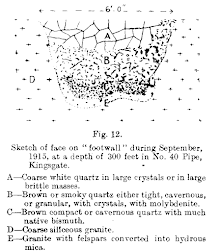
There has been considerable speculation as to the reasons why the Kingsgate mineralisation occurs in the way it does. The best that can be said is that the pipes are separate intrusions into the main plutonic mass, whose location has been controlled by the pressure and temperature conditions prevailing at the time. The pipes are very irregular in shape and structure and frequently change direction, dip and diameter as they are followed downwards. Some are characterised by branches, others by their variation in diameter from a few centimetres to many metres across. In some the minerals completely fill the pipe, in others there are open spaces lined with huge quartz crystals. All are of the same essential character, being composed in part of granite in which the felspar has been altered to sericite, in part of quartz and in part of veins and segregations of ore minerals.

Sach's Pipe (the Old 45) has been studied in some detail. More information on individual pipes is to be found in the next chapter.


Song Studies. Bible studies based on hymns and songs
Shoalhaven District Geology.

Wednesday, 6 March 2024

KINGSGATE MINES Part 2

KINGSGATE MINERALS

(This is the second chapter of this booklet on Kingsgate Mines.) When I get time, I'll fix up all the chemical formulae.

The modern visitor to Kingsgate mines is probably hoping to find specimens of the minerals for which the place is justly famous. It is a classic locality for quartz crystals and molybdenite in particular but many more minerals are likely to be found on the dumps. More than 30 different minerals have been recorded at Kingsgate and the collector should have no difficulty finding specimens of at least 10 of these. They fall into two categories: ore minerals and rock-forming minerals and this is the order in which we shall examine them.


ORE MINERALS

Molybdenite, MoS2. This is the most obvious of the metallic minerals, easily recognised by its high metallic lustre and extreme softness. With a hardness of only 1 - 1.5, it will readily mark the fingers when handled. It is widespread on the mullock heaps, standing out against the white quartz in which it is frequently embedded. Careful searching will reveal specimens showing the hexagonal crystal shape and others displaying alteration to the yellow mineral ferrimolybdite. Specimens may also be found in which the crystals are found together as small rosettes.
Bismuth, Bi. A much more difficult mineral to find on the dumps, due to its greater value. Native bismuth is a brittle silver-white mineral with a distinctly pinkish tinge. It is relatively soft (2 - 2.5) and has a shiny silver-white streak, which is easily seen when specimens are rubbed against a piece of white quartz. The bismuth was usually found as masses between quartz crystals and occasionally as wires within white or transparent quartz.
Wolframite (variety ferberite), (Fe,Mn)WO4. A dense, brown to black mineral, wolframite is found scattered in pieces through the dumps. It has a prominent cleavage, making it easy to recognise because of the flat, lustrous surfaces created. It is comparatively scarce, but easy to recognise.
Cassiterite, SnO2 (tinstone). It was this mineral which the first prospectors were seeking at Kingsgate in 1872. It is scarce, being found in few of the pipes. Cassiterite is a hard, dense mineral, usually brown or black. Despite its colour, its streak is white unlike any of the other dark minerals likely to be found at Kingsgate.
Arsenopyrite, FeAsS (mispickel, arsenical pyrites). Another mineral with a metallic lustre, arsenopyrite is silver-white in colour with a black streak. It is much harder than bismuth and easily distinguished from it by its streak. It occurs plentifully in some pipes, usually as large masses in white reef quartz but is scarce in most.
Bismuthinite, Bi2S3. This is a rare mineral which was encountered in some pipes at Kingsgate in masses several kilograms in weight. It resembles native bismuth, with which it is often found, but is somewhat darker both in colour and streak.
Ferrimolybdite, Fe2(MoO4)3.8H2O (molybdite, molybdic ochre). Once thought to be molybdenum oxide, this canary yellow mineral is a common alteration product of molybdenite, with which it is often found. When found as crystals it occurs as tufts of acicular crystals up to 1 cm long.
Powellite, CaMoO4, with some tungsten substituting for molybdenum. Powellite forms by the alteration of molybdenite and is itself altered to ferrimolybdite. It is a rare mineral found in tetragonal crystals of bipyramidal habit of hardness 3.5 - 4. Its colour varies from yellow through greenish blue to nearly black.
Bismite, Bi2O3 (bismuth ochre). This is a somewhat earthy yellow to greyish green mineral found as an oxidation product of bismuth and bismuthinite, with which it is likely to be found. It occurs as fibrous masses in cavities in the quartz.
Bismutite, (BiO)2CO3. Another secondary bismuth mineral, this was one of the first bismuth minerals to be recognised at Kingsgate. It occurs as straw-yellow pseudomorphs after bismuthinite. It has sometimes been mistaken for gold by beginners, as it occasionally turns up in the prospector's dish. Unlike gold, particles of bismutite can easily be crushed to a powder.
Scorodite, FeAsO4.2H2O forms as an oxidation product of arsenopyrite. It is found as green botryoidal masses lining cavities in reef quartz formerly occupied by arsenopyrite.
Pyrrhotite, FeS, is occasionally found on the dumps. It has a metallic lustre, with a typically yellow-grey colour. Its streak is dark greyish black. The mineral is frequently slightly magnetic and oxidises on exposure to an iridescent surface.
Pyrite, FeS2, is occasionally found as pale brass-yellow cubes with an intense metallic lustre. Its streak is typically greenish black.
Chalcopyrite, CuFeS2, resembles pyrite but has a more golden colour. Surfaces are frequently tarnished and iridescent.
Galena, PbS, occurs from time to time as brilliant grey cubes, which cleave easily in a cubic fashion. Galena is denser than most minerals with a metallic lustre.
Galenobismutite, PbBi2S4, has been reported as greenish silver coloured masses up to 5cm across in molybdenite.
Ikunolite, Bi4(S,Se)3, is a rare mineral which has been reported at Kingsgate as plates and foliated masses with a prominent basal cleavage, lead-grey in colour.
Joseite, Bi3TeS, is another rare mineral reported from Kingsgate. It is a soft greyish mineral displaying one perfect cleavage.
Cosalite, Pb2Bi2S5, has been found from time to time as metallic lead-grey needle-like crystals.
Pyrargyrite, Ag3SbS3 (ruby silver), has been reported as soft, deep red prisms. The crystals display an adamantine lustre.
Gold, Au and Silver, Ag, have appeared in significant quantities in some chemical analyses of ore samples.
Brookite, gudmundite, sphalerite, chalcocite, covellite, marcasite, smythite, goethite, ilsemannite, tungstite and wulfenite have all become recorded at various times.

ROCK-FORMING MINERALS
Quartz (SiO2) is the overwhelmingly obvious mineral to be found at Kingsgate. The pipes consist essentially of quartz in which the ore minerals are embedded. The quartz varies a great deal from massive


to individual crystals up to 200 kg in weight, from milky to glass clear, smoky and rutilated. It is found as single crystals and as a variety of twin types. It is found alone and in company with crystals of the various ore minerals. Specimens of all types can still be found on the dumps and have made their way into collections all over Australia and beyond.
Rock Crystal. This is the term applied to the colourless variety of quartz which is much sought after for faceting, carving and just as specimens. It is not as simple as it might seem to find completely flawless material. Thousands of collectors have been to Kingsgate over the years to gather just such specimens. It will probably be necessary to search the more remote dumps and to dig deeply into them to locate the best material.
Smoky Quartz (cairngorm). Also much sought after, the colour of this variety ranges from a smoky yellow to brown or almost black. The colour is believed to be the result of partial decomposition of the quartz by exposure to radiation
from radioactive minerals. The presence of aluminium substituting for silicon atoms in the crystal lattice seems also to be essential. Smoky quartz can sometimes be decolorised by heat, the effect becoming noticeable above 225o and rapid above 450o. Some of the colour can be retained in a deeply coloured specimen by stopping the process before it is complete.
Citrine is the yellow to orange variety of quartz. Its colour appears to be due to the presence of small amounts of colloidal hydrated iron (111) oxide. Good specimens are not easy to find at Kingsgate, but some types of smoky quartz, evidently containing the necessary impurity, will turn into citrine when heated.
Amethyst, the much admired violet variety of quartz, is even scarcer at Kingsgate than citrine, which it much resembles chemically. The colour is due to the presence of iron (111) possibly substituting for silicon in the lattice. Strong heat will convert amethyst into an orange citrine.
Quartz with Inclusions. The following have been reported from Kingsgate: rutilated quartz (grass stone) contains fine needles of rutile (TiO2) penetrating the quartz. It has occasionally been found at Kingsgate. Arsenopyrite, bismuth, bismuthinite and molybdenite are fairly frequently found.
Calcite (CaCO3) occurs in white cleavable masses in some pipes.
Muscovite mica, as the variety sericite, is plentiful in the pipes, where it has been produced by the alteration of the original felspar. It can be recognised by its silky lustre, softness and lack of visible crystals.
Topaz and garnet (variety unspecified) have been reported from the dumps. Finding these would have to be regarded as a bonus.


Sunday, 4 December 2016

TOURMALINE IN QUARTZ LOCALITY WALLANGRA NSW

TOURMALINE IN QUARTZ LOCALITY WALLANGRA NSW

Photo by Wwoofa via the Australian Lapidary Forum
This is a well-known mineral collecting locality in northern NSW, on the western edge of what is commonly called the New England region. Unfortunately it is a place I’ve never visited so I am depending on the descriptions of others.

The Inverell Tourism website has this to say:  

“Wallangra Fossicking Area. Wallangra located north of Inverell has an area near the hall where you can hunt for Black Tourmaline in Quartz, once again this is a dry fossicking area. Contact Details: Wallangra Hall, Wallangra (65km north of Inverell) Ph: (02) 6728 8161.”

You may not find that particularly helpful. Knowing that the spot is near the Hall is good, but you also need to know that this is on the left hand side of the Yetman road. I’m sure you will find the place OK without ringing Wallangra. 
The spot is open freely to fossickers. Please do the right thing and leave your mechanical diggers at home. As well as your specimens, take home all your rubbish and other people’s as well if you come across any.

There is a stack of information available on the Australian Lapidary Forum. I suggest you become a forum member so you can access it. Here. You can then contribute to the Forum by telling members about your visit to Wallangra.

I will point out at this stage that Wallangra and Wallangarra are quite different places. The latter is just across the NSW border into Queensland on the New England Highway.
This is an extract from the Inverell 1:250000 geological map. It shows that Wallangra is situated in an area marked Pg (Permian Granite, actually part of the Bundarra Suite).
The Australian Stratigraphic Units Database contains this definition of the “granites” of the Bundarra Suite:
Coarse- to very coarse-grained, porphyritic and equigranular (biotite)-(muscovite)-(garnet)-(cordierite) granite and leucogranite; K-feldspar megacrysts abundant in places.” This is the host rock in which the Wallangra tourmaline in quartz bodies are found.

I have been unable to find any account of the detailed geology of the occurrence.
Mindat (here), however, regards the site as significant. Here is what a search on the location produces:
“Latitude & Longitude (WGS84):
29° 13' 54'' South , 150° 53' 4'' East
Latitude & Longitude (decimal):
Located south of Texas, Qld.
Wallangra (in Northern New South Wales) was the site of a quarry, the area is now a designated Fossicking area. There is a quartz outcrop which contains tourmaline.

You will notice that the word ‘tourmaline’ is in quotes. This is because tourmaline is the name of a mineral family, rather than an individual mineral. In this case, the mineral is schorl – commonly called black tourmaline. If you want to read more about the tourmaline group, check this Mindat reference here.
Photo by Wwoofa via the Australian Lapidary Forum
Photo by earthound via the Australian Lapidary Forum