KINGSGATE MINES Part 4
DESCRIPTION AND LOCATION OF THE MAIN PIPES
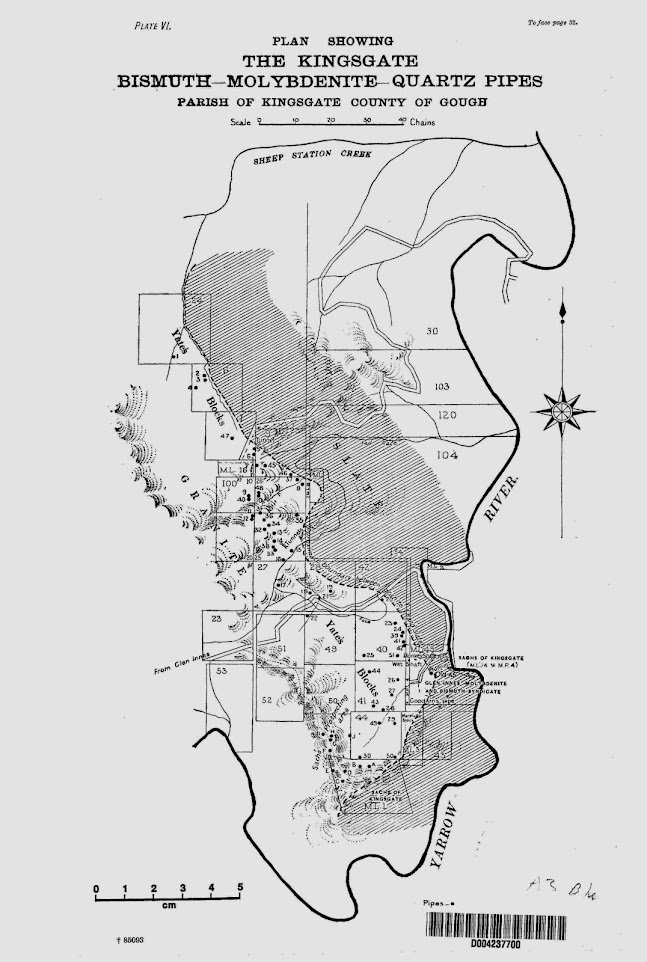
For much of this information, we are indebted to the geologists of the NSW Geological Survey, in particular to Mr. E.C. Andrews, whose work "The Molybdenum Industry in New South Wales" was published in 1916. To avoid any confusion with names and the numbering system, it needs to be understood that the numbers appearing on the map in Andrews' report are those assigned by Mr. W.H. Yates to pipes under his control in 1915. Numbers appearing as part of names refer to the Portions of Parish Kingsgate and therefore relate to the original mining leases of the 19th Century. Pipes under Sachs' control at that time or under the control of other miners and prospectors were either not numbered at all or assigned letters. The descriptions which follow treat the pipes essentially in order from the north, Portion by Portion.
Portion 24.
1. Known as “Quinn's Find” - a prospect only.
Portion 6. (originally leased by Feeney, Rush and Say in 1879)
2. Dips at 1:2; a branching pipe, an unimportant producer.
3. Prospect only.
4. Small vertical pipe.
Portion 1.
47. The “Swamp Blow”. A prospect north of the present main road in a swampy area.
5. Usually known as the "One and Nine" from its location on the portion boundaries. This pipe has been an important producer of both bismuth and molybdenite and is apparently the site of Quinn's discovery of "sulfur" in 1877. The upper part of the pipe has been mined as an open cut which now lies quite close to the main road. In cross section, the pipe varied in diameter from 1 to 8 metres. It has been mined to a depth of about 85 metres, and consisted essentially of a gangue of well crystallised quartz with rich deposits of bismuth and molybdenite. Vughs lined with crystals of white and black quartz crystals up to 1.2 metres in length were found. Several branches of the main pipe were noted at depth.


6. Prospect only.
Portion 9.
7. The “Water Shaft”, “Tin Shaft” or “Tin Show”. This was the second pipe to be prospected in 1872. Small quantities of cassiterite were found in the quartz. The pipe, which is nearly vertical, has been prospected to a depth of 12 metres.
45. Known as "Jack's at Home". Prospect only.
46. Prospect only.
Portion 100. (Originally in four blocks, leased by Quinn & Ferguson in 1879)
9. “Bill Miller's Hole”. A fairly large but poor pipe prospected to a depth of 10 metres.
40. “Jubilee Pipe”. A surface prospect only.
48. Prospect only.
10. The “Wolfram Pipe”, “Wolfram Blow”, “Old 26” or “Little Tunnel”. This particular pipe was the one originally prospected in 1872. While it contains a little cassiterite in a massive white quartz gangue, the pipe is notable for the quantities of wolframite and arsenopyrite it contains along with the usual bismuth and molybdenite. Both can be readily found on the dumps. Initially mined as an open cut, it was later worked by a tunnel to a depth of 30 metres. The maximum diameter reported was 3.7 metres. Commercial quantities of wolframite were mined here in 1950-52.
31. Prospect only.
37. “Tom Key's Hole” or the “Chimney Shaft”. A fairly small, steeply dipping pipe worked to a depth of over 45 metres.
8. The “Black Shaft” or “26 East”. This large pipe produced substantial quantities of ore in the early days, when it was followed down to a vertical depth of over 40 metres.
11. “Mick's Shaft”. A vertical pipe of moderate dimensions.
12. Prospected at the surface only.
35. The “Granite Shaft”. Instead of the usual quartz, the molybdenite and bismuth were found here in a gangue of granite, in which the felspar was largely sericitised. The pipe, a moderately deep one, dips steeply and branches into two at depth. It has been mined to a depth of at least 40 metres. For the first 30 metres, the ore occurred in the granite itself. One branch continued as granite, the other was a typical quartz pipe.
36. Known as the “25 Northwest No.2 Pipe”. It is small and has been prospected to only a shallow depth.
34. The “Mount Morgan Pipe” is a large pipe (up to 7.6 metres across) located at the highest point on the plateau, on top of a rocky knoll on the left of the access track. It dips quite steeply to a depth of more than 50 metres below the surface. The workings are still fairly accessible but should not be entered.
32. The “25 West”. A surface prospect only.
13. The “25 North”. This pipe has been one of the largest producers of both bismuth and molybdenite at Kingsgate. It has been followed down to over 150 metres from the surface, at first at a fairly shallow angle, then more steeply when it became necessary to sink a vertical shaft to facilitate mining. The pipe branches at several places. The quartz gangue was in places marked by large vughs which were lined by huge quartz crystals. The dumps of this mine yielded quantities of radio quality quartz during World War 11.
14. The “Old 25”. This was another pipe first mined as an open cut and later mined underground. Mined to a depth of 76 metres, the Old 25 was one of the largest pipes on the field. A haulage tunnel was driven into the base of the workings to facilitate access. Most of the workings are still accessible but should not be entered. The mine lies to the right of the access track and its dump also yielded crystals during the war. More recently the dumps have yielded many fine mineral specimens.

38. “25 South No.2”. A fairly shallow prospecting shaft.
33. “25 South”. Similar to its neighbour.
15. “Weidmeyer's Cutting”. A vertical pipe of moderate dimensions mined to a depth of 30 metres.
16. “Martin's Hole”. A small vertical pipe.
Portion 27.
17. Prospect only.
Portion 28.
18. “Schoolhouse Blow”. Prospect only.
19. “Magazine” or “Windlass Shaft”. Prospect only.
21. “28 South”. Prospected on the surface only.
Portion 42.
20. Prospect only.
Portion 49.
22. Prospect only.

Portion 40. (Yates' original lease of 1880)
23. “Forty North”. This was another of the very productive pipes. It was originally abandoned because of its poor showing on the surface, but rich bismuth ore was later discovered in it by the discharge of water from a race eroding the weathered granite. The pipe descends in stages to at least 30 metres below the surface. The quartz gangue was at times either massive or cavernous, containing grey and black crystals. Both bismuth and molybdenite were mined in large amounts.
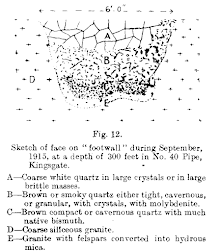
24. “Forty” adjoins Forty North to the south. The surface rubble of white quartz yielded much bismuth which was followed downwards in an open cut for about 6 metres. In later years the pipe was followed vertically for about 90 metres, continuing to produce quantities of bismuth and lesser quantities of molybdenite. The quartz occurred in massive form and as large white and smoky crystals.


41. “Road Block Pipe”. A small unimportant hole about 10 metres deep.
42. Prospect only.
25. “Forty South”. Another small producer about 20 metres deep.
51. “The Reef Blow” is a pipe with three main branches, initially mined in a gently inclined tunnel which later became vertical. Both bismuth and molybdenite were produced.

Portion 41.
44. A small pipe mined for quartz in 1942.
26. “Jim Marshall's Hole”. A surface prospect only.
27. Prospect only.
28. Known as the “Arsenic Blow”, “Arsenic Shaft” or “Hagen's Tribute”. This is another of the pipes known from the early days of the field. Like many of the pipes, it was first mined as an open cut but subsequently underground as the dip of the pipe changed from vertical to nearly horizontal and vertical again as the pipe was followed down. The pipe was approximately 3 metres in diameter and was traced downwards for about 60 metres. The gangue was, as usual, quartz - sometimes massive and frequently cavernous. Some of the vughs encountered were more than 3 metres long, lined with large quartz crystals. In 1942 the old shaft was dewatered and the mine worked again specifically for quartz crystal. The Arsenic Shaft appears to have been the main producer of crystal at Kingsgate.
43. “Christie's Blow”. A prospect only.
ML 45 and Adjoining Leases.
“Monkey Shaft”. Described as more of a vein than a pipe, it was worked to a depth of about 13 metres. At depth the vein gave way to a true quartz pipe. This deposit was among several in this corner of the field tested for crystal in 1942.
“The Wet Shaft”, “Water Cut” or “Wet Cut”. This pipe was mined to a depth of about 60 metres, producing good yields of both bismuth and molybdenite. The quartz gangue was noticeably cavernous and the dumps were turned over for crystal during the war.
The “Old 45” or “Sachs' Pipe”. This pipe is the most famous of all those at Kingsgate because of the exceptional masses of molybdenite extracted from it. It probably produced more mineral than any other pipe on the field. It was first worked for bismuth but was then abandoned because of the high molybdenite content of the ore which made it difficult for the miners to produce a pure bismuth concentrate. In 1902 the mine was reopened by Mr. Valentine Sachs, who soon discovered a large vugh more than 15 metres across. This extraordinary cavity was lined with massive quartz and molybdenite crystals. One piece of solid molybdenite removed was said to have weighed about 1 tonne. After producing many tonnes of ore, Sachs evidently lost the course of the pipe and therefore sold the mine. The new owners subsequently discovered that the pipe had constricted to only 50 cm in diameter. They followed the pipe downwards, but no further bonanzas of ore were located. The total length of the workings approaches 100 metres, most of which is still accessible.
“Goodwin's Pipe” was mined to a depth of about 60 metres at an angle of about 45o. Good yields of bismuth and molybdenite were obtained. Because access was from a cutting just above creek level, the workings are now completely flooded. Calcite cementing pieces of quartz pipe material was a feature of this pipe.

Portion 44.
29. “The Hard Blow”. A small pipe mined to only a shallow depth.
49. Prospect only.
30. “Sachs' Folly”. Prospected on the surface only.
50. “Nield's Blow”. Prospect only.
ML 90 (formerly “Sachs' Prospecting Area”.
F. This pipe, also known as “Potter's Claim”, yielded fairly large amounts of ore.
G. Known as the “Reef Blow”. (Not to be confused with Pipe 51 also of that name.) This is another of those pipes which appeared more like a vein in places. It produced good yields of molybdenite.
H. “The Giant Blow” is well known for the very large doubly terminated quartz crystals found in the gangue. These were first located right at the surface. The pipe produced quantities of bismuth and molybdenite from an open cut which was then followed down into underground workings. These are still accessible.
I. No details available.
J. No details available.
ML 55 (formerly “Pauline Speckhardt's Lease”
A. A small pipe containing both bismuth and molybdenite in minor quantities.
B. This fairly small pipe produced many tonnes of rich ore containing both metals.
C. This pipe, followed down for more than 30 metres, produced bismuth in fair amounts.
D. No details available.
E. No details available.
Mines South of Yarrow River.
From Kingsgate, the boundary between the Permian metasediments and the granite has been traced southwards for many kilometres. Ore bearing pipes have been found in two areas across the Yarrow River not far from the Kingsgate pipes and obviously related to them.
Portion 19, Parish Yarrow.
The “Dodger Claim” (“Maurer's Claim”) includes 4 pipes near the granite boundary.
1. Yielded good quantities of both bismuth and molybdenite. The pipe is relatively large by Kingsgate standards.
2. A smaller pipe with smaller quantities of molybdenite.
3. Another pipe of moderate size followed down for at least 20 metres. Good quantities of both bismuth and molybdenite were mined along with large amounts of well crystallised quartz, generally smoky.
4. Similar to the previous pipe.
Portions 20-23.
More pipes have been prospected in this area, a little north of the Pretty Valley Road.
https://johnsbluemountainsblog.blogspot.com/2013/12/links-to-all-blog-entries-and-relevant.html All Blue Mountains blogs and videos
All New England and other Geology blogs and videos
Limestone Caves of NSW
Song Studies. Bible studies based on hymns and songs
Shoalhaven District Geology.


