Search This Blog

Showing posts with label garnet. Show all posts

Sunday, 24 March 2024

  WHERE ARE SAPPHIRES FOUND?


                                   pyrope, sapphire and zircon from Yarrow Creek

There are two kinds of gem deposits in the Glen Innes area: Primary and Secondary or alluvial. 

The primary deposits are those containing the gems in the original rock or weathered material formed from it. The secondary deposits are concentrations found in present day streams, abandoned stream channels and deep leads or buried stream channels. 

The only primary deposits the casual fossicker is likely to meet are at the DeJon mine on the Gwydir Highway at Elsmore and at the Wellingrove Fossicking Reserve.


                                                      Quarry at DeJon mine

At the Wellingrove Reserve, there is no sign of the overlying basalt, though it is visible in road cuttings just before the turnoff into the Reserve. The sapphires are found in reddish clay overlying the Wellingrove granite. This clay is evidently the weathered remains of volcanic material ejected over the area immediately before the outpouring of the basalt. Fossickers will soon notice the absence of typical water worn sand and pebbles in the so-called "wash". The greatest concentration of gems is in the bottom few centimetres of clay, which may be buried beneath several metres of soil.

 
            Wellingrove wash and granite boulders

Alluvial deposits are found in stream beds all over the district. The major requirement for finding concentrations of gems is to be searching in an area where there are outcrops of bedrock in the creek to act as traps. Otherwise the dense gemstones will be buried deeply in the gravel and inaccessible to the casual fossicker. This rules out most of Reddestone, Wellingrove and Furracabad Creeks and the Beardy Waters. In other places, it's necessary to think of how the water behaves in a major flood, because this is the only time the dense gemstones are actually shifted. They will then be deposited in places where there is a sudden decrease in stream velocity such as in the lee of boulders, below rapids etc. These are the places to identify and search for the best results.


     Where Do Sapphires Come From?


Throughout NSW and Queensland, sapphires are nearly always found in areas where basalt rock has been eroded. Occasionally one turns up in a basalt floater (loose piece of solid basalt) or in soil overlying basalt rock and clearly formed from it by weathering. 

It's believed that some sapphires are found throughout the extensive basalt lava flows of New England, brought up from deep within the Earth by rising magma some 37 million years ago. The result is that almost every stream between Glencoe and Dundee, Glen Elgin and Inverell holds its quota of marvellous blue, green, yellow and particolour sapphires.


                                  digging for gravel in Yarrow Creek

                                                 Sapphires from Rainy Swamp
Investigations at Elsmore and in the Kings Plains and Wellingrove areas suggests that the greatest concentration of sapphire and the other dense minerals is in volcanic ash beds which lie below the first great lava sheets. These are the product of the explosive activity which took place when the volcanic cycle commenced. Weathering of these rocks has released the precious stones to be concentrated in modern creeks and ancient deep leads by virtue of their greater hardness and density. 

The distribution of sapphires suggests that other explosive centres may have been located near Mt. Slow, Glencoe, Furracabad and Bald Nob. The search is on to locate sapphire bearing rocks in these places. If these deposits prove to be economic, Glen Innes will be a source of precious stones for hundreds of years to come.

   Minerals Found in Gem Gravels. 

The process of concentration which takes place during sieving should separate out all the dense minerals found in the wash. The other materials, mostly pebbles of various rocks and quartz (as worn

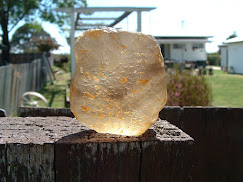
                                                 Smoky quartz Yarrow Creek


          quartz from Garnet Corner

crystals and vein fragments) have specific gravities between 2.5 and 3.1.  That is, they are 2.5 to 3.1 times denser than water. Of these, only some of the crystalline quartz is likely to interest the fossicker.

 The denser minerals, with their specific gravities, are as follows:   

               corundum (sapphire & ruby)    4.0                                                       pleonaste (black spinel, commonly called blackjack)   4.1               zircon    4.7                                                                                            garnet (most often pyrope)  3.5-3.7                                                        topaz   3.4-3.6                                                                                         enstatite  and hypersthene   3.2 - 3.5       

              tourmaline (the black schorl variety)   3.0 - 3.3                                    cassiterite   6.8-7.1                                                                               "ironstone" (ferruginous bauxite)  2.5 - 4.0                                                   depending  on the iron content. 

Not all of these will be found together. The typical sapphire concentrate will consist of ironstone, corundum, zircon, garnet and pleonaste; less commonly topaz and enstatite will turn up. Tourmaline and cassiterite can be expected in tin areas around Backwater, Tingha, Emmaville and Torrington. 

 How to Recognise the Various Minerals. 

Nothing beats being shown by an expert, but it is comparatively easy to distinguish the various minerals.  Ironstone is opaque, reddish brown to black which crushes to a red powder.  Pleonaste is invariably found with sapphire in New England. It is black and lustrous and occasionally confused with corundum, especially on bright sunny days.

                                        Pleonaste (spinel, blackjack) Rainy Swamp

 Corundum is the mineralogical name of the mineral whose transparent varieties include ruby and sapphire. The name ruby is reserved for the red variety of corundum, all other colours being
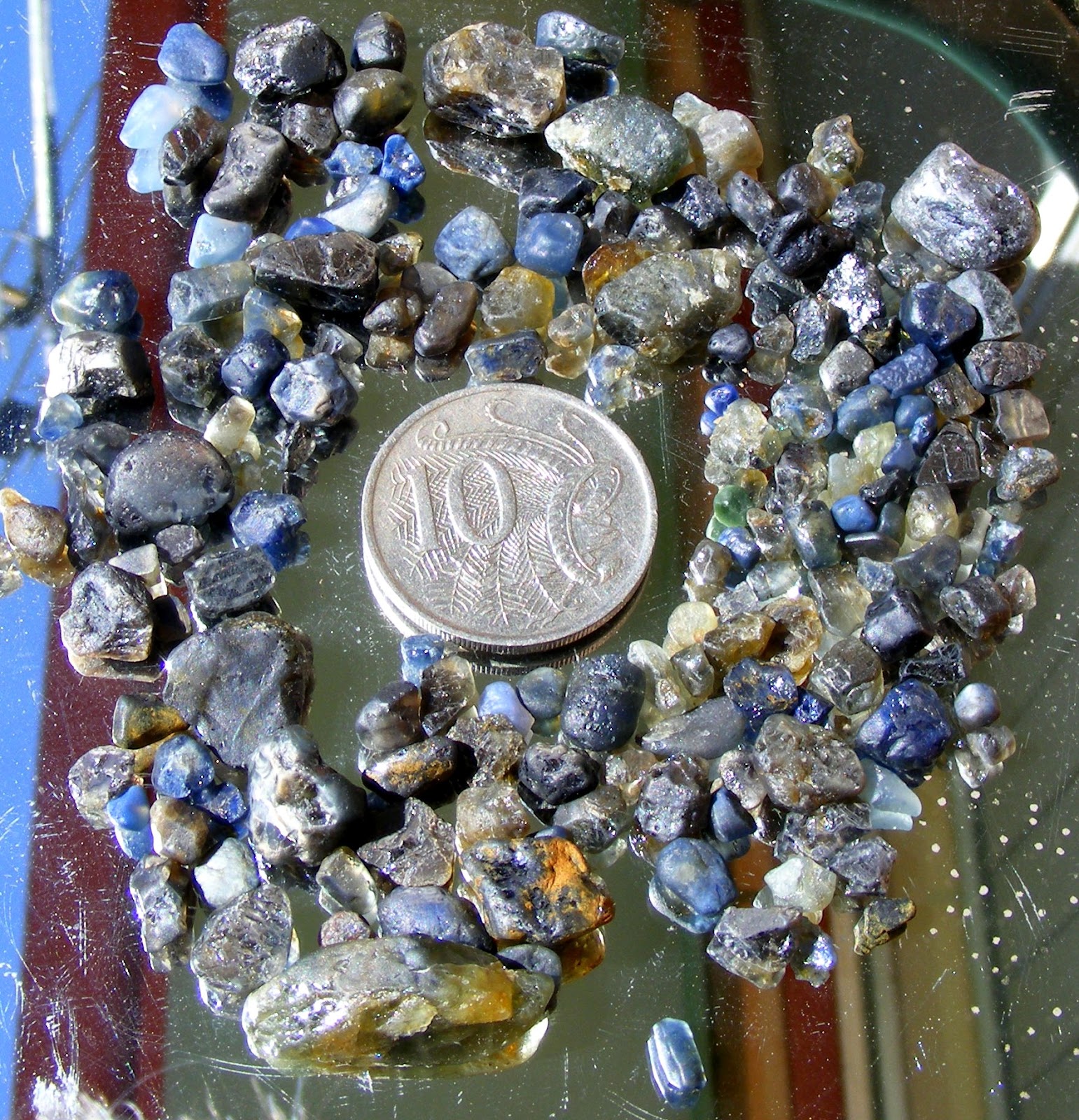
                                                  Corundum from Yarrow Creek
known as sapphire. To the miner, the term "corundum" means the nongem quality mineral.  It occurs in barrel shaped hexagonal crystals, pieces of crystals and rounded fragments. These may be up to 4 cm across. If broken, the mineral usually displays flat, very lustrous parting surfaces. Colour zoning both along and across the crystal is common.  

Zircon is plentiful, being usually a reddish brown colour. It can, however, be pale pink or colourless. The stones may show some crystal faces but are more often rounded.  

                                                     Zircon from Pretty Valley

Zircon is a highly lustrous mineral with a high refractivity which sets it apart from other minerals in the wash. Zircons have been found up to 3 cm across. 

Pyrope garnet is characteristically deep red in colour and usually dull in lustre (unlike zircon). Garnets frequently have rough, irregular surfaces, again unlike zircons which often display flat cleavage surfaces.

                                              Pyrope garnet from Yarrow Creek

Topaz is found as colourless to pale blue pebbles, sometimes 2 or 3 cm in diameter. Highly reflective cleavage surfaces are commonly seen, which distinguishes topaz from quartz but not necessarily colourless zircon. Topaz pieces tend to be larger than the other gemstones.

 
       Topaz Scrubby Gully Torrington

Enstatite and hypersthene are somewhat softer minerals than the others. They are occasionally found as brownish green to emerald green fragments which are quite unlike others in the wash.


                                          Enstatite and Hypersthene Yarrow Creek

Tourmaline is occasionally seen as black or brownish crystal fragments which have a characteristically rounded triangular cross section. The sides are often deeply striated.


Tourmaline and sapphire Pretty Valley

Cassiterite is exceptionally dense and has a distinctly metallic lustre. It is usually reddish brown to black and highly lustrous. 

Equipment Needed for Sapphire Fossicking.


Because water is nearly always available, gem fossicking around Glen Innes is comparatively simple. The basic equipment you need is a pair of sieves (coarse and fine), a shovel (the longer the handle the better), a plastic bottle with lid for your finds and a pair of tweezers for picking them out of the concentrate. 

For working hard ground like that at Wellingrove Reserve, a pick and crowbar are very useful. They are also invaluable in moving rocks in stream beds. A long handled shovel can help you get gravel out from under boulders, from pot holes and from cracks in the bedrock. A one metre steel probe is very useful for locating holes under sand or gravel while a jam tin and perhaps a piece of steel wire are excellent for scraping wash out from between boulders where gems have a tendency to get caught. Many people find a yabby pump valuable for extracting wash from cracks and other hard-to-get-at places underwater. 

Song Studies. Bible studies based on hymns and songs

Shoalhaven District Geology.

John G. Paix  ©

Glen Innes Business Enterprise Centre

June 1991


Saturday, 9 May 2015

THE RUBY HILL GARNET DEPOSIT NEAR BINGARA, NEW ENGLAND NSW AUSTRALIA

THE RUBY HILL GARNET DEPOSIT NEAR BINGARA, NEW ENGLAND NSW AUSTRALIA
Google Earth photo - the signpost coming from the north
I’ve passed by this place several times without going in. As there are many references to it as a fossicking area, I suppose it must be open to the public, though whether this is public or private land I’m unable to say. It is well signposted, more visibly so when travelling south from Bingara, being on the right hand side of the road linking Bingara to Barraba (commonly called the Fossickers Way). The most precise distance from Bingara I’ve read is 18.6km, though from what point in the town this was measured is not stated. There are no rubies there – they proved to be garnets – but there have been several dubious claims of diamonds being found there. More of this later.
The earliest reference to the place appears to be DA Porter, “Notes on Some Minerals and Mineral Locations in the Northern Districts of NSW”, published in the Journal of the Royal Society of NSW in 1894. I read this many years ago and there is no certainty that Porter is referring to the present day Ruby Hill. The next reference is by JM Curran, in the same Journal in 1896. JF Lovering quotes Curran as saying that a red, pyrope-rich garnet was found in a coarsely-crystallising basic rock within the basalt at Ruby Hill. The easiest reference to read from the early days is in “The Mineral Resources of NSW”, by EF Pittman, 1901. Search Trove.
Photo from Pittman, 1901
Pittman wrote as follows: “A small hill, about eighty feet in height, which is intersected by several basalt dykes, was pegged out some years ago by a miner named Butt, who was attracted by some red crystals in the basalt. Under the impression that these crystals were rubies, Butt drove a tunnel, forty feet in length, in one of the hard basalt dykes, and only desisted on being informed that the red stones were garnets and of no value.” Pittman went on to tell of the search for diamonds on the same hill. He gives the date 1889 for the formation of a diamond prospecting syndicate. The upshot of this was that “Ten diamonds, weighing in the aggregate four and one-eighth carats, were obtained from it. The diamonds were remarkable in that they each had a distinct depression or pitting on one of the faces.
The first edition of “Gemstones”, Mineral Industry series 18, page 66, (1960) (DIGS reference R00050829) throws doubt on the validity of this discovery; however it also states that “in 1922 ER Dickens treated alluvial material in the vicinity of Ruby Hill, and it is reported that some hundreds of small diamonds were obtained but were not sold”. I wonder what became of them? There are other Ruby Hills in NSW so perhaps these diamonds came from elsewhere. The second edition (1980, DIGS reference R00050830) mentions only the earlier find.

Map from Pittman, 1901
What emerges from these readings is that the garnets were found both in the breccia, which makes up much of the hill, and in the dykes which intrude it. They are apparently derived from fragments of eclogite found in the breccia (along with many other types of rock, which is typical of brecciated volcanic pipes) and in the later basalt, which they could have entered from the breccia when it was intruded by the basaltic magma. They might also have been carried up from a considerable depth from the same source rock as that penetrated by the breccia.
Lovering addressed the nature of the eclogite fragments in an article in the Journal of the Royal Society of NSW in 1964 (Volume 97, pages 73-79). He stated “Eclogites occurring as inclusions in igneous pipes are particularly important in that they may well represent direct samples of the upper mantle caught up in the magma of the pipe during its passage to the earth’s surface”. He prefers to call the inclusions “garnet granulite” and adds that individual xenocrysts of garnet are also found in the breccia and dykes, no doubt derived from the breakdown of the granulite.

Because of the (apparently) superficial resemblance of the occurrence to South African diamond bearing kimberlite pipes, there has been quite a lot of interest in this locality as a potential source of diamonds.  One such report, written by GL Rolfe for Anaconda Australia Inc. in 1979 (DIGS reference R00015604), concluded that the rocks there were unlikely to be diamantiferous. Commenting on the garnets, the report states “The most common xenocryst in both the breccia and basalt is garnet. The garnets are generally orange pink in colour, size varies from 1 to 5mm. Reaction of the garnet with the magma during ascent to the surface has resulted in kelyphitic rims one to two mm wide. The keliphytic rims consist of clay mineral and zeolites. The rims are wider in the basalt than the breccia, indicating a longer period of disequilibrium between the garnet and magma”.

Reports from fossickers of outings to Ruby Hill are few. Some say they found little or nothing, others that there were numerous small garnets in the soil. Obviously, the soil derived from the dykes is going to be the most productive, so these places need to be identified from the map, rather than by digging at random. It seems that nearly all the gems will be found in a small sized mesh sieve, a coarser sieve being used to remove larger pieces of rock etc. There will probably be no water on site, so dry sieving to concentrate the gems followed by a dip in water you will need to take with you is the most likely approach. There may be water in nearby Hall’s Creek, but this will almost certainly be on private property.

Another useful reference:  A thread from Prospecting Australia’s website (here). There are some interesting photographs in this thread, but as there is no mention of sapphire being found at Ruby Hill in any other reference, the bluish stones may have come from somewhere else. Some object for scale (such as a coin) in the photos would have helped.


Saturday, 12 April 2014

THE CASCADES, YARROW CREEK NEAR GLEN INNES NSW AUSTRALIA

THE CASCADES, YARROW CREEK 
NEAR GLEN INNES NSW AUSTRALIA
The Crossing is in the centre, the long pool is on the left
This section of Yarrow Creek lies between Garnet Corner and The Crossing (click to go to the Blog List page for information on these locations). In dry weather, it is possible to park in the centre of the area, otherwise walking upstream from the crossing is the best option.
It can be divided into three parts. The uppermost is the cascade area itself. Immediately below Garnet Corner, the stream descends steeply through a drop of about 10 metres to a blockup of large granite boulders. There are numerous small pools and cracks on the way down. Some good gemstones have been extracted here using yabby
The beginning of the pool
pumps. However, a lot of sand has washed down from the Garnet Corner diggings as fossickers have dug and sieved over the years. This may have been washed further downstream by floods since the beginning of 2012.
Boulder blockup and the pool
No doubt there will be good finds made amongst the boulders one day, but it will take a lot of work to shift all but the smallest of them.
The middle section is a long
pool, commencing immediately below the boulders. Within 2 or 3 metres of the rocks, the water will be over your head. Good for swimming (brr) and perhaps ideal for a wetsuit and snorkel equipped fossicker. The 13 carat sapphire in the picture came from the edge of the deeper water. There are some large boulders in the pool immediately after the deepest part and then sand takes over. Some nice cutters have been found among the boulders.
Finds including the 13 carat stone
The final section leads to the rock barrier which crosses the creek another 100 metres or so further downstream. Wash is scarce along here but some good stones have come from the pool just above the barrier and by digging under the left bank (facing downstream).
There is an extensive alluvial flat on this bank which probably conceals former channels of the creek. Naturally, no-one knows where they are and they are probably loaded with gems.
  https://johnsbluemountainsblog.blogspot.com/2013/12/links-to-all-blog-entries-and-relevant.html All Blue Mountains blogs and videos
My finds at Minerama in 2007

Thursday, 6 March 2014

KELLY’S HUT CREEK NEAR GLEN INNES NSW AUSTRALIA

KELLY’S HUT CREEK NEAR 
GLEN INNES NSW AUSTRALIA

Kelly's Hut Creek

It’s surprising how few tributaries Yarrow Creek has upstream of the bridge at Pinkett. A search on Google Earth will allow you to follow the creek upstream from the bridge quite easily. On the left bank (facing upstream) there are a few minor tributaries, of which Rainy Swamp Spring Creek is the most interesting. See the blog on Rainy Swamp for information here. Further up there are Mt Slow Creek and Log Paddock Creek near the Mt Slow road bridge. Upstream from there Frenchies Swamp Creek is practically the only one. (See here for information.) These creeks all carry gemstones.
There are one or two right bank tributaries, but the only sizable one is Kelly’s Hut Creek which rises in the 
distant hills towards Guyra as does Yarrow Creek itself. This creek is crossed on the Mt Slow road about 2km before the Yarrow Creek bridge. There is no signpost, however.
The point where Kelly’s Hut Creek meets the Yarrow is not easy to locate. It is a very rocky place and it so happens that the tributary runs under a lot of boulders and is easily missed. For those who are familiar with Dwyer’s property (for a long time a popular fee-paying fossicking area), you take the tracks leading upstream as far as you can go, park near the dingo fence, go through the big hole in it and walk upstream. Kelly’s Hut Creek is on the right about 400 metres further on.
If you actually do this, you will be trespassing on the neighbouring property. All of Yarrow Creek and Kelly’s Hut Creek past the dingo fence are not on Dwyer’s property. Please note that on the various Minerama and Baptist Church Fossicking Group trips, we did have permission from the landowner but as the access track is not passable when the country is wet such outings were rare. In fact, the last of these would have been in 2004.
For about 2km above the junction there are many rocky areas. The gemstones are identical to those in Yarrow Creek, including pyrope garnets. The creek then turns at right angles and runs parallel to Yarrow Creek, though at a distance of about 2km from it. From this bend on, no more gemstones have been found. Searches of the literature through DIGS were fruitless; in fact the one reference I was able to locate stated categorically that, apart from quartz, at no point were any gemstones located. Nevertheless, the various maps showing the location of sapphire deposits in New England always include Kelly’s Hut Creek, showing the very part that I am claiming is barren to be productive and the part that we know is productive to be barren.

If you ever get a chance to fossick here I know you will enjoy it. You will also be able to verify what I have written about the place. As a guess, I think that the lower part of Kelly’s Hut Creek is probably a former course of the Yarrow, though just how this came about I can’t work out. The presence of garnet in the alluvium (found only in the Yarrow and some of its tributaries) implies that at some point in time a source of garnet must have been somewhere upstream. The geology of the catchment area of Kelly’s Hut Creek today suggests that this is unlikely. If someone unravels this mystery one day I will be glad to correct any errors in what I have written here.


Friday, 31 January 2014

FRENCHIES SWAMP CREEK NEAR GLEN INNES NSW AUSTRALIA

FRENCHIES SWAMP CREEK 
NEAR GLEN INNES NSW AUSTRALIA

The Yarrow Creek junction 2013
Frenchies Swamp Creek is one of only two tributaries of Yarrow Creek over the entire length of the two properties we have regularly fossicked. The other one is a mere trickle and hardly noticeable. Just who Frenchie was I have no idea, but the swamp bearing his name covers a swathe of country between Yarrow Creek and the Mt Slow road near the Henry River bridge.

You might think that swamps are unlikely places to find gemstones, but it has been the swampiest ground at Pretty Valley that has been the most productive, so it doesn’t pay to jump to conclusions. In the case of Frenchies Swamp, the creek flows through some rocky areas along its course and gemstones have been found in all these places. I have followed the main creek up to the limit of the last swamp (about 4km from Yarrow Creek)
3 carat zircon
and gemstones are to be found in the gullies running into the swamp there. There are more small tributaries running into the swamp around its margin but I never had the opportunity to check these out.

The junction with Yarrow Creek is not obvious except when water levels are high. It can be followed up to the first swamp (about 400m) through rocky ground with quite a bit of typical quartz gravel in places. How this got there through kilometres of swamp is one of those little mysteries. The junction is at “Sue’s Favourite Spot”, just below the "Glory Hole" section.
                                                                                 The gemstones are identical to those in Yarrow, with perhaps a lower 
Corundum fragment 1998
garnet percentage. The fact that there is any garnet at all is significant, because it implies that the source of the mineral must be in the catchments of both creeks. There is another possibility, that the swampy ground represents a former course of the Yarrow and that there are in fact large gemstone deposits present under the swampy areas.

It’s been quite a while since I checked out anything but the lowest part of the creek. In fact, it’s been 12 years since I went much further than that. Access is complicated by the fact that we never had a 4 wheel drive vehicle and relied on others on the few times we went there. Walking from The Crossing is the best bet, allowing 20 minutes to the point where the track crosses the creek.

I’m looking forward to hearing of good finds there one day. The landowner certainly believes that Frenchies Swamp Creek has more potential than Yarrow Creek. I hope he proves to be correct.
Check out the videos and blogs of Sue's Favourite Spot and the Glory Hole for more information and ideas
Photographs are unfortunately rather few. Sorry about that. The only one of a day's best finds was done on a scanner. Be assured that there were many good finds made over the years.
Best finds from an outing in 2006

Monday, 6 January 2014

“DOWN THE HILL” YARROW CREEK, NEAR GLEN INNES NSW AUSTRALIA

LIST OF ALL BLOG ENTRIES TO DATE

10.2 and 4.9 carat sapphires
Thanks to Google Earth. "Down the Hill" is in the centre
Many visitors to Glen Innes have enjoyed a day’s fossicking at “Down the Hill”, both on our Wednesday Baptist Church trips and during Minerama. I’ve written about the place in two previous blog entries (Quartz at Down the Hill and The Big Sapphire). Several videos have also covered the area (one, two and three). Click on the links to go there. 
                      “Down the Hill” lies downstream of “Through the Fence” and upstream of “Underground River”.

Down the Hill is an area with many rocky outcrops and, most notably, an abandoned channel through which the creek only flows in flood. At one time this was the most productive area, but the old diggings have mostly filled with sand and no-one seems too keen to spend the day removing it when they could search among the rocks. At the lower end of the channel the wash was at least two metres below the overlying sand. The last we saw of it, there was lots of black jack and    
Cliff O'Brien digging in the old channel 1998
presumably gems, but we were beaten by inflowing water and finally by a flood which filled up the hole with sand. Maybe one day, during a drought, fossickers will get another chance to experience the thrill of working this spot.
At some time, probably in the 1960’s, a small mining operation operated at Down the Hill. There was the remains of a shed or hut when I first visited the place in 1988 but hardly any sign of actual mining. This was on the flat immediately below where we parked. The only other sign of previous visitation was a Tamworth 1 pint milk bottle I found in the creek just below old hut site.
4.3 carat sapphire, 11.6 carat zircon (July 2008)
One day's small finds - December 2009
The gemstones are the usual ones for Yarrow Creek – sapphire, zircon, pyrope garnet, the occasional topaz and enstatite and, of course, quartz. My one and only cuttable ruby came from here, as well as my largest sapphire, best dog’s tooth crystal and biggest quartz 
0.3 carat ruby
Snowing July 2008
crystal. This is more a    reflection of the sheer quantity of wash we found than its superior  quality.
Snowing: July 2008 - the same day as the gemstone group above was found! July 2008